Wednesday, February 11, 2009
Simulation vs Reality
What I have learned from using Mikes Bikes is that the offline mode simulation is good for practice but it shouldn't be heavily relied on for making our real life decisions in the online mode. It is impossible to predict human behavior and emotions with a simulation. Our decisions should be based on business cirucmstances to maximize our learning.

The Doom Loop
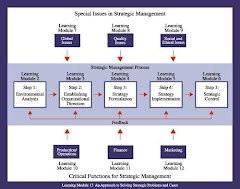
The book "Good to Great" talks about the Doom Loop. The Doom Loop starts at the juncture of environmental analysis and strategy formulation, where the company does not choose an appropriate strategy to align the company with its environment. It also comes from a failure at the juncture of strategy implementation and formulation, where a company abandons its strategy before seeing the results of longterm decisions and chooses a new strategy as a reaction instead of as the result of careful environmental analysis.
What do you think, where does the Doom Loop starts for most failed companies?
What do you think, where does the Doom Loop starts for most failed companies?
Wednesday, February 4, 2009
An Example...Imitating vs. Innovating
In module 4, the example of how Japanese electronic companies were quite successful in the 1970s and 1980s in copying American technology is mentioned. By avoiding many R&D costs, the Japanese companies improved their competitive position significantly. In my Management of Innovation class we read an article, Not made in Japan, that discusses how Japan is now having issues with sustaining in the digital age. The article says that this is due mostly to the country's corporate culture as the Japanese market is disinclined to creativity and the many barriers between company divisions. To me this shows that one can only get so far with imitating and a strong long term company strategy is vital.
Imitation vs. Innovation
It is easier to imitate new products, innovative production methods, and marketing, but is this sustainable? Will it give you advantage over time? I think that the key to sustainability is innovation not imitation. Innovation can come from getting access to key resources or customers and achieving size advantage in market. This is where strategy formulation is key to overcoming the challenge of sustainability.
look forward, reason backwards
I'm about half way through an interesting read: "The Art of Strategy" by Dixit and Nalebuff. The book applies the principles of game theory to decisions made in life and business. The authors advise that better decisions can be made by looking forward and reasoning backwards. Competitors will react in their interests to any move you make, so you must anticipate their moves before acting. Seems obvious...but probably isn't followed as often as it should be.
Sunday, February 1, 2009
Don't copy your competitors (Except...)
Don't just copy successful competitors' corporate-level or business-level strategies. Unless they trip up, you'll always be a couple steps behind them. Discover untapped market segments rather than following competitors into crowded market segments. However, companies should definitely benchmark successful functional strategies, as long as these strategies fit into the company’s chosen corporate-level and business-level strategies.
The Power of a Plan
The company I work for begins its plan for next year less than halfway through the current year. It seemed odd at first, but I quickly realized the power inherent in knowing where you want to go, how you want to get there, and the steps you need to take along the way. By developing a solid mission and vision, and aligning goals and objectives, that company (and ours) are better set up for success.
Subscribe to:
Posts (Atom)